Variable Capacity Wine Tanks Explained: How the Floating Lid Works
Air is the enemy of finished wine. Once fermentation is over, every square centimetre of wine exposed to air is a chance for oxidation and spoilage. Traditionally that meant one rule: keep the vessel full. The trouble is, home batches rarely match tank sizes exactly, and volumes change every time you rack or bottle.
The variable capacity tank solves that problem, which is why it is the most popular style of tank among home winemakers. Here is how it works and how to get the best from one.
How a variable capacity tank works
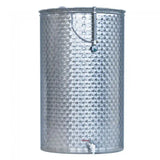
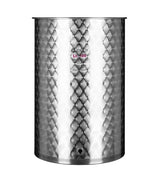
The tank has an open top. Instead of a fixed lid, it uses a floating lid: a stainless disc slightly smaller than the inside of the tank. Around its rim is a hollow rubber seal, a bit like a bicycle inner tube. The parts work together like this:
- The lid is lowered on its rods or a lifting arm until it sits on, or just above, the surface of the wine.
- A hand pump, connected to the seal by a thin hose, inflates the seal.
- The seal expands outwards and grips the tank wall, closing the gap between the lid and the tank.
- An airlock in the centre of the lid lets any gas from the wine escape without letting air in.
Because the lid sits wherever the wine level is, a 300 litre tank can hold 300 litres or 120 litres with the same small air gap. That flexibility is the whole point.


Photo: Algor
The parts of a floating lid kit
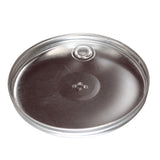
- The floating lid. Sized to the tank's internal diameter. Spare floating lids come in sizes from 420 mm to 1770 mm.
- The inflatable seal. The rubber tube around the rim. Seals are sized to the lid, such as the 40 to 42 cm seal for a 75 litre tank lid.
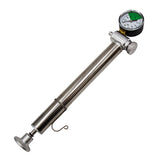
- The hand pump and gauge. A small hand pump for floating lids suits most home tanks, while a large hand pump with gauge suits lids from 130 to 230 cm on tanks from 1500 to 15,000 litres. A pump gauge shows the seal pressure.
- The inflation hose. The thin line between the pump and the seal, such as the 8 mm hose for variable capacity tank seals.
- The airlock and extension. An airlock extension raises the airlock clear of the lid so you can see it working.
- Lifting gear. Larger lids are heavy. A lid lift T-bar arm suits tanks from 500 to 1250 litres.
Setting the lid, step by step
- Clean and sanitise the lid, the seal and the inside of the tank above the wine line. See How to Clean and Sanitise a Stainless Steel Wine Tank.
- Check the seal is fully deflated before you lower the lid.
- Lower the lid level, until it sits on the surface of the wine. Keep it level as it goes down so it does not jam.
- Inflate the seal with the hand pump until the gauge reads your lid's recommended pressure. The Olimpia gauge we sell lists 0.6 bar as the recommended working figure; always go by the instructions for your own lid and do not over-inflate.
- Fill the airlock with water or a weak sulphite solution and fit it in the centre of the lid.
- Fit the dust lid over the top to keep dust and insects off the floating lid.
Adding a layer of paraffin oil
For long storage, many winemakers add a thin layer of food-grade paraffin oil on top of the wine before lowering the lid. The oil floats and forms an extra barrier against air in the small gap between the lid and the seal. When you later drain the tank from the bottom, the oil stays on top, so stop before the oil layer reaches the valve, and take the last of the wine out carefully.
Looking after the seal
- Check the pressure every week or two. Seals lose a little pressure over time, and temperature changes affect the reading.
- Never inflate the seal with the lid out of the tank. Without the tank wall to push against, the seal can over-stretch or burst.
- Deflate fully before you raise or lower the lid.
- Keep the seal clean and dry between uses, and store it out of sunlight. Rubber hardens with age even when the tank is not in use.
- Replace the seal and hose at the first sign of cracking, flattening or slow leaks.
Troubleshooting a lid that will not hold
- Pressure drops overnight: check the hose first, especially near the valve where it bends. Then check the pump valve, then the seal itself.
- Lid sits crooked: deflate, lift, and lower it again slowly and level.
- Wine seeps above the lid: the seal is under-inflated, damaged or the wrong size for the tank.
- Airlock stays dry: refill it. An empty airlock is an open hole in the lid.
When ordering spares, measure the lid's outside diameter and the inside diameter of the tank, or bring the old part into Laverton North or Epping, and we will match it.

Photo: Algor
Which variable capacity tank?
Our Algor 304 stainless steel flat base tanks and Minox Italian flat base tanks both come with a floating lid kit. For help choosing a size and base, see How to Choose a Stainless Steel Wine Tank.

Pre-order wine tanks from our next container
Can't see the size or style you need, or want to plan ahead for vintage? We can take pre-orders for wine tanks and bring them in on our next container. Contact us for more information.